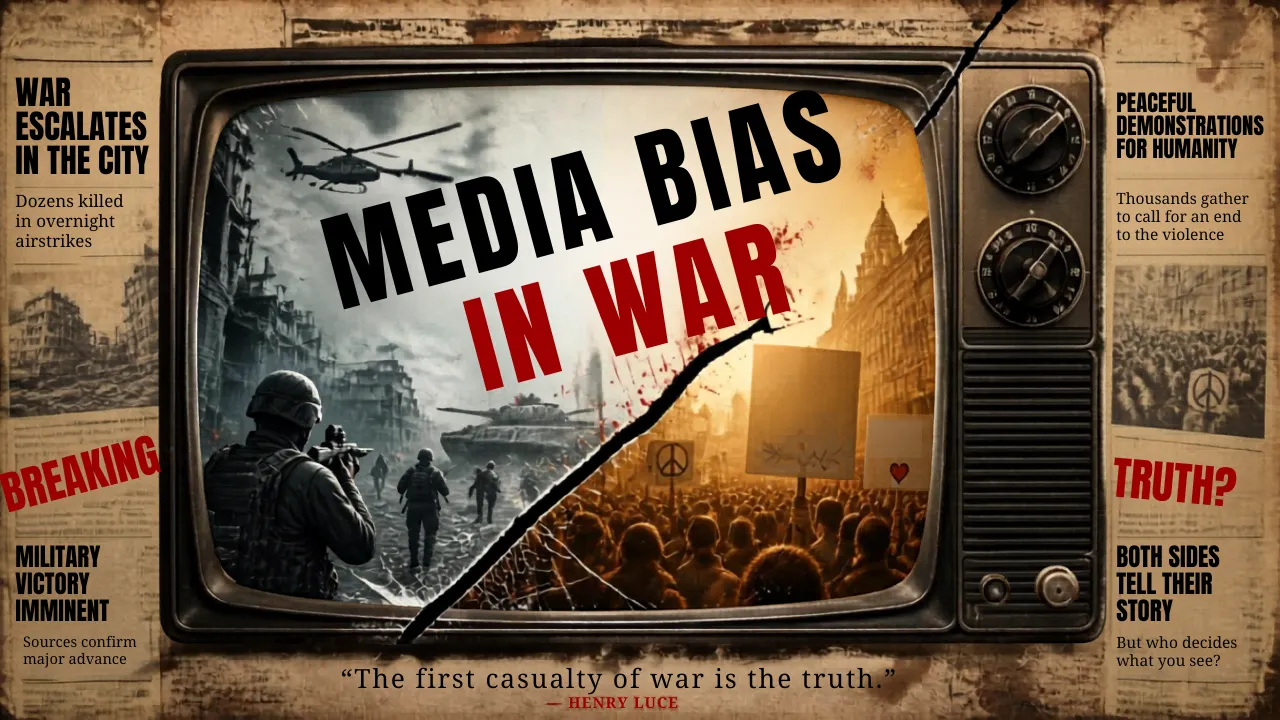
In today’s world, the way we see modern conflict is rarely a reflection of reality, but rather a result of the narratives we’re fed. War is often framed in such polarised terms that it immediately turns into an “us vs. them” argument. This shifts public attention toward political narratives; instead of looking at what’s actually happening to people, the news usually focuses on the power struggle. As a result, the human cost of war is often overlooked. We need to change how we view these conflicts. My point is that this excessive polarisation, driven largely by media framing, forces us to view war through ideological lenses that ignore the hardship civilians face.
How the News Shapes What We See
The way news outlets choose to frame a story gives them an incredible amount of power. Through their framing, story selection, and use of visual media, news outlets have immense power to influence public opinion. (Minges, 2023).
You can see this bias in action by looking at how different sites reported the recent conflict with Iran.
For example, in Brussels Signal’s. “The most overwhelmingly one-sided war victory, by America alone,” the article describes the war as a complete victory for the U.S., saying one side destroyed 90% of the other side’s military power while losing only 8 U.S. soldiers (Black, 2026). This shows how the article frames the war in a very one-sided way that clearly pushes a narrative.
The language used by Brussels Signal in their article makes the conflict sound like one side has completely dominated the other. But Al Jazeera’s article gives a much more balanced and realistic picture. They agree that the joint U.S. and Israeli strikes have seriously impacted Iran’s missile and drone capacity, but they say that being weakened isn’t the same as being totally finished.
Iran went from launching 167 missiles and 541 drones in the first 24 hours to just four missiles and six drones by day 15 (Pietromarchi, 2026). Even with those massive losses, Iran still has enough power to hit key infrastructure and keep the Strait of Hormuz completely blocked, leaving hundreds of ships just sitting there in fear of an attack and impacting the global economy severely. Vali Nasr, a professor at Johns Hopkins University, pointed out that if Iran can keep pushing up global oil prices, “it will inflict equal or more damage to the US than American bombs in Iran.”
But it’s not just about the narrative; it’s also about the specific words the media chooses to use.
A study by the Centre for Media Monitoring (CFMM) looked at over 32,092 news segments and 3873 articles and found that the BBC used emotional words for Israeli victims four times more than for Palestinians. They even used the word “massacre” 18 times more for one side than the other. These differences matter because language does not just describe events; it helps create a story around them. The study also found that Israeli deaths got 33 times more coverage, and that while the BBC interviewed over 2,350 Israelis, it only spoke to about 1,085 Palestinians on TV. BBC presenters also shared the Israeli perspective 11 times more often than the Palestinian perspective, with 2,340 mentions compared to 217.
Beyond the words they use, bias also shows up in what news outlets choose to leave out.
“What the media chooses not to report can be as impactful as what it does report. Omitting certain facts, events, or perspectives can skew public understanding of the conflict and lead to a one-sided view” (Minges, 2023). For instance, while the Hamas-led attacks on October 7 were mentioned in at least 40% of the BBC’s online coverage, only 0.5% of those articles ever mentioned the decades-long occupation of the West Bank, Gaza, and East Jerusalem. This lack of context makes the conflict seem like it started out of nowhere rather than being part of a much longer history. On top of that, the BBC pushed 38 different interviewees to condemn the October 7 attacks but never once applied that same kind of pressure to people defending Israeli actions. When one side’s perspective appears that much more often, it becomes hard not to feel like the media is picking favourites.
From biased words to real-world danger
While subtle bias is one thing, it gets way more dangerous when governments use the media to push an aggressive agenda. A clear example of this is the Global New Light of Myanmar newspaper. This state-run paper didn’t just show a slight preference; it actively produced hate speech against the Rohingya Muslims. By printing these one-sided and violent narratives, they influenced the way people talked about the conflict on social media, too. It created a world where people felt it was “normal” to hate a specific group.The authorities carried out illegal executions of thousands, tortured and detained men and youths, sexually harassed women, and deliberately burned hundreds of villages in a targeted manner. They shot at men, women, and children fleeing from their homes in villages throughout the region. They planted landmines that maimed and killed people in the border area. As a result, more than 700,000 Rohingya have fled to Bangladesh (Amnesty International, 2018).
How Media Bias Messes with Our Perspective
When you look at all these examples together, it’s easy to see that media bias isn’t just a coincidence; it changes how we actually process a war. These examples show that when the media gives one side more attention than the other, it can shape people’s opinions and how they understand the conflict.
Instead of helping people see the conflict’s complexity, this kind of reporting pushes them toward a single narrative in which one side appears more victimised and more important. Over time, this framing can make the war seem more one-sided than it really is and can lead people to pay less attention to the human cost of the conflict.
Biased news sources often follow a similar pattern: they highlight certain facts, leave out others, and quote only one side. This makes the story feel one-sided, even when it is based on real events. Social interactions also can shape political preferences and exacerbate polarisation across communities (Grosjean et al., 2024).
Why Our Brains Pick Sides
Research suggests that news framing can have a substantial impact on audience perspectives, especially during combat, which may further aggravate the conflict (Kaur & Arora, 2025). If you have a very strong opinion on a topic, your brain becomes hypersensitive to any information that contradicts your view. You tend to see neutral facts as “attacks” and believe the media is purposely favouring the other side.
This is known as the Hostile Media Effect. It is a theory that explains why people on opposite sides of an issue can watch the exact same news report, and both walk away convinced that the coverage was biased against them. For this reason, war must be reported in a more balanced way to ensure that civilian suffering is treated as a human tragedy rather than being reduced to a mere statistic.
Isn’t It Easier to Just Pick a Side?
Some may argue that viewing wars in polarised terms is a natural psychological shortcut that helps people make sense of them quickly. They believe that by categorising wars into clear, extreme narratives, they can process complex geopolitics more easily and feel they are taking a meaningful stance against what they consider “wrong.” The problem isn’t picking a side; it’s that polarisation makes us ignore the facts about the other side’s suffering. Simplifying wars may help us feel we have taken a meaningful moral stand, but it is a narrow way to view them. By turning real-world tragedies into black-and-white narratives, we make it easier to ignore the painful reality of those who are suffering.
Conclusion
My point is that when we only see these conflicts through political lenses, we stop seeing real people and just see numbers. Like we saw with the news about Israel, Palestine, the US, Iran and Myanmar, letting a one-sided story take over makes it way too easy to ignore what people are actually going through. We get so caught up in an ‘us vs. them’ argument that we end up ignoring the other side’s pain and completely overlooking the suffering of regular people. If we want to be fair, we have to look past our own opinions and realise that pain is a tragedy no matter which side someone is on.
References:
Black, C. (2026, April 22). The most overwhelmingly one-sided war victory, by America alone. Brussels Signal. https://brusselssignal.eu/2026/04/the-most-overwhelmingly-one-sided-war-victory-by-america-alone/
CfMM. (2025, June 16). BBC on Gaza-Israel: One story, double standards. Centre For Media Monitoring. https://cfmm.org.uk/resource/bbc-on-gaza-israel-one-story-double-standards/
Grosjean, P., Jha, S., Vlassopoulos, M., & Zenou, Y. (2024, February 21). Political trenches: War can create both political solidarity and extreme polarisation | CEPR. CEPR. https://cepr.org/voxeu/columns/political-trenches-war-can-create-both-political-solidarity-and-extreme-polarisation
International, A. (2018, June). Myanmar: “We will destroy everything” : Military responsibility for crimes against humanity in Rakhine State, Myanmar [Burmese]. Amnesty International. https://www.amnesty.org/en/documents/asa16/8630/2018/my/
Kaur, A., & Arora, A. (2025). Beyond the Battlefield: Framing Analysis of Media Coverage in Conflict Reporting. https://doi.org/10.48550
LEE, R. (2018). Extreme Speech in Myanmar: The Role of State Media in the Rohingya Forced Migration Crisis. International Journal of Communication . https://ijoc.org/index.php/ijoc/article/view/10123
Minges, M. (2023, November 21). How does the Media Impact Public Perception About War? | School of International Service | American University, Washington, DC. American University, Washington DC. https://www.american.edu/sis/news/20231121-how-does-the-media-impact-public-perception-about-war.cfm
Pietromarchi, V. (2026, March 16). US says it has destroyed Iran missile capacity: How is Iran still shooting?. Al Jazeera. https://www.aljazeera.com/news/2026/3/16/us-says-it-has-destroyed-iran-missile-capacity-how-is-iran-still-shooting